
Do Acoustic Panels Really Soundproof a Room?
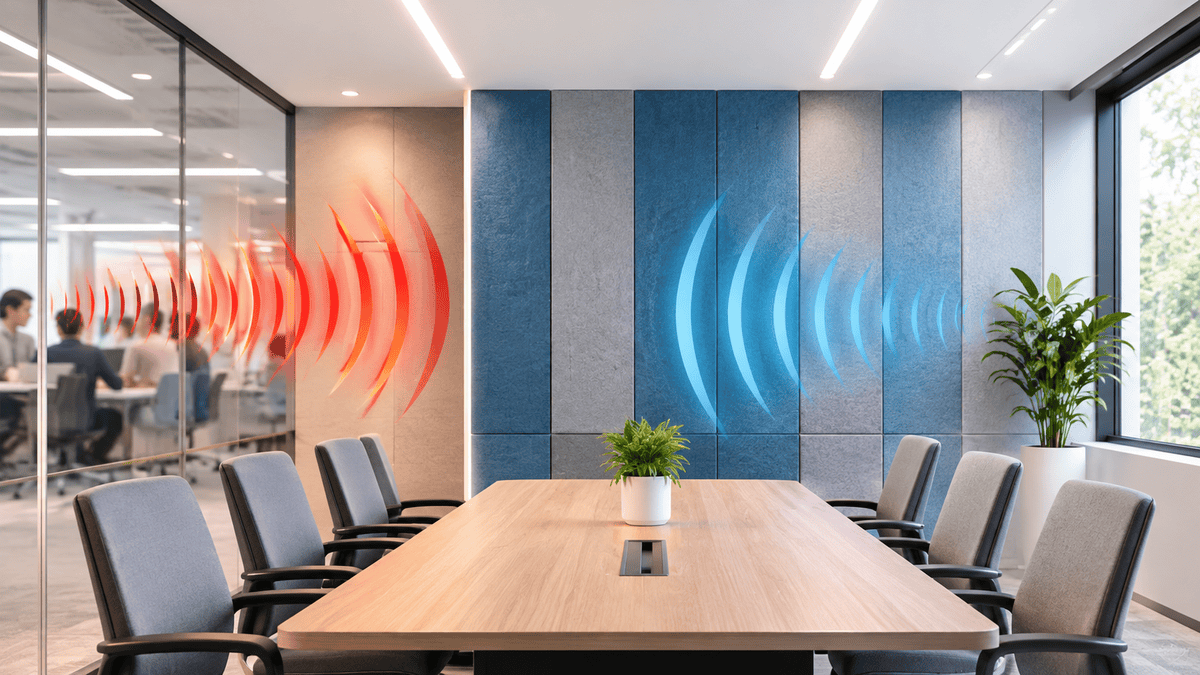
Noise can make even a well-designed room uncomfortable. In an office, conversations from nearby desks can become distracting. In a conference room, voices may echo against glass walls and hard floors, making discussions difficult to follow. At home, traffic noise or sounds from neighbouring rooms can disturb your daily activities.
To solve these problems, many people consider installing acoustic panels. But before investing in them, one question is worth asking: Do acoustic panels really soundproof a room?
The answer is no, acoustic panels do not completely soundproof a room. They primarily absorb sound reflections, reduce echo, and improve sound clarity. However, they do not prevent most sound from travelling through walls, doors, or windows.
This does not mean acoustic panels are ineffective. They play an important role in improving indoor acoustics, particularly in offices, conference rooms, classrooms, restaurants, and commercial buildings.
Understanding how acoustic panels work, what they can achieve, and where they should be installed can help you select the right noise-control solution for your space.
What Are Acoustic Panels and How Do They Work?
Acoustic panels are materials designed to absorb sound energy and reduce unwanted reflections inside a room. They are commonly installed on walls and ceilings where sound tends to bounce off hard surfaces.
When someone speaks inside a room, sound waves travel in different directions. Some reach the listener directly, while others hit walls, ceilings, windows, and floors before reflecting back into the room.
In spaces with too many reflective surfaces, these sound waves overlap and create reverberation. As a result, speech becomes less clear, and the room may feel noisier than expected.
Acoustic panels help control this problem by absorbing part of the sound energy that reaches them. Porous materials allow sound waves to enter their structure, where friction and other physical processes convert a small amount of acoustic energy into heat.
This reduces the amount of sound reflected back into the room.
For example, consider a conference room with glass partitions, tiled flooring, and a plain gypsum ceiling. When several people speak, their voices reflect from multiple surfaces. Installing suitable acoustic wall panels and ceiling treatments can reduce these reflections and make conversations easier to understand.
Acoustic panels are available in several materials, including PET felt, polyester fibre, fibreglass, mineral wool, and fabric-wrapped absorbers. Their performance depends on material properties, thickness, installation method, and the frequencies being absorbed.
Do Acoustic Panels Really Soundproof a Room?
Acoustic panels can make a room sound quieter by reducing reflected sound, but they cannot provide complete soundproofing.
The main reason is that sound absorption and sound isolation are two different processes.
Acoustic panels control sound within a room. Soundproofing systems reduce the amount of sound passing from one space to another.
For example, imagine two meeting rooms separated by a lightweight partition.
If you install acoustic panels inside the first room, you may notice less echo and clearer conversations. However, people in the second room might still hear those conversations because sound continues to travel through the partition.
To improve privacy between the rooms, you may need an appropriately designed partition system, acoustic insulation, sealed joints, and suitable doors.
This distinction is particularly important in commercial buildings. A meeting room may need acoustic panels to improve speech clarity and a sound-insulating partition to prevent confidential discussions from being overheard.
Therefore, acoustic panels work best when used for their intended purpose: controlling reflected sound and improving the acoustic quality of a space.
What Is the Difference Between Soundproofing and Sound Absorption?
Although people often use these terms interchangeably, they address different noise problems.
Sound absorption reduces the amount of sound reflected inside a room. It helps control echo and reverberation, making speech and other sounds clearer.
Soundproofing, also called sound isolation, focuses on reducing sound transmission between spaces. It involves controlling how sound passes through walls, ceilings, floors, doors, windows, and structural connections.
Understanding the difference can prevent unnecessary spending on products that do not solve the actual problem.
| Feature | Sound Absorption | Soundproofing |
|---|---|---|
| Main Purpose | Reduces echo and reverberation | Reduces sound transmission |
| How It Works | Absorbs reflected sound energy | Limits sound passing between spaces |
| Common Materials | PET acoustic panels, fabric panels, acoustic ceiling tiles | Insulated partitions, acoustic doors, layered wall systems |
| Main Application | Offices, classrooms, conference rooms | Private meeting rooms, recording studios, sound-isolated spaces |
| Performance Measurement | NRC and frequency-specific absorption data | STC, Rw, and other sound-isolation measurements |
| Expected Result | Clearer sound inside the room | Less sound entering or leaving the room |
For instance, a restaurant with hard flooring and glass walls may need acoustic panels to reduce reverberation from customer conversations.
A recording studio, however, may require both acoustic panels for controlling reflections and sound-isolating construction to prevent outside noise from entering.
In many commercial projects, combining both approaches provides better results than relying on one solution.
Do Acoustic Panels Block Outside Noise?
One of the most common questions people ask is whether acoustic panels can stop traffic noise, construction sounds, or conversations from neighbouring rooms.
Standard acoustic panels do not significantly block outside noise.
Outside sound usually enters through building elements such as windows, doors, walls, ventilation openings, and gaps around partitions.
Even when acoustic panels cover a large portion of a wall, sound may continue to pass through the underlying structure.
For example, suppose your office is located near a busy road. Installing PET acoustic panels may reduce echo inside the office, but it will not necessarily prevent traffic noise from entering through the windows.
In this situation, improving window seals, selecting suitable acoustic glazing, or upgrading other building elements may be more effective.
Similarly, if conversations from an adjacent office are clearly audible, the problem may involve insufficient partition insulation, gaps around doors, or sound travelling through the ceiling space.
Acoustic panels can improve comfort after these transmission problems are addressed, but they should not be treated as a substitute for proper sound isolation.
Are PET Acoustic Panels Effective for Noise Reduction?
PET acoustic panels are a practical choice for reducing reflected sound in offices, meeting rooms, educational institutions, and other commercial spaces.
PET stands for polyethylene terephthalate. Manufacturers process polyester fibres, often including recycled PET, into felt-like acoustic panels.
The fibrous structure allows sound energy to enter the material and reduces reflections within the room.
PET panels are particularly useful where acoustic performance and interior appearance are both important.
Unlike some traditional acoustic treatments, PET felt panels are available in different colours, patterns, shapes, and decorative finishes. Designers can incorporate them into feature walls, ceiling installations, and other architectural elements.
Benefits of PET Acoustic Panels
1. Better Speech Clarity
In meeting rooms and classrooms, excessive reverberation can make conversations difficult to understand. PET acoustic panels help reduce reflected sound, which can improve speech clarity when the panels provide sufficient absorption and coverage.
2. Reduced Echo in Commercial Spaces
Large offices often contain glass partitions, hard flooring, and painted walls. These surfaces reflect sound and contribute to reverberation. PET panels can help absorb some of these reflections and improve acoustic comfort.
3. Flexible Interior Design
PET panels can be manufactured in different colours, thicknesses, patterns, and shapes. This allows architects to integrate acoustic treatment into the room’s design instead of treating it as an additional decorative element.
4. Recycled Material Options
Many PET acoustic panels contain recycled polyester fibres. This can support projects that prioritise recycled-content building materials. However, recycled content and environmental claims should always be verified through product documentation.
5. Multiple Installation Applications
Depending on the product, PET panels can be installed as wall treatments, ceiling features, hanging baffles, or suspended acoustic elements.
For projects where both sound absorption and visual appearance matter, PET acoustic panels provide a useful option.
Where Should Acoustic Panels Be Installed for the Best Results?
Installing acoustic panels in the correct locations is just as important as choosing the right material.
A room may contain several reflective surfaces, but treating every wall is not always necessary. The goal is to identify where unwanted sound reflections occur and install suitable acoustic materials in those areas.
Acoustic Panels for Office Walls
Open-plan offices often experience noise from conversations, telephone calls, meetings, and daily activities.
Hard walls and glass partitions can reflect this sound throughout the workspace.
Installing acoustic wall panels in selected locations can reduce reverberation and improve the overall acoustic environment.
For example, panels placed near collaborative workstations or meeting areas may help reduce reflected speech noise.
However, acoustic panels cannot eliminate direct conversations from nearby desks. Office layouts, workstation spacing, and acoustic screens may also need consideration.
Acoustic Panels for Conference Rooms
Conference rooms require clear communication, especially during presentations and video meetings.
When sound reflects repeatedly from glass walls and hard ceilings, participants may struggle to understand speech.
Acoustic panels installed on appropriate walls and ceilings can reduce reverberation and improve speech intelligibility.
For rooms used for confidential discussions, sound-insulating partitions and doors may also be necessary.
Acoustic Panels for Classrooms
Good classroom acoustics help teachers communicate clearly with students.
Rooms with excessive reverberation can make speech difficult to understand, particularly for students seated farther from the teacher.
Acoustic wall panels and ceiling systems can reduce unwanted reflections and improve listening conditions.
The required treatment depends on classroom size, occupancy, background noise, and existing materials.
Acoustic Panels for Restaurants
Restaurants often use glass, tiles, stone, and other hard finishes.
Although these materials create attractive interiors, they can reflect conversations, music, and background noise.
Acoustic ceiling panels, wall treatments, and suspended baffles can help reduce reverberation.
This can make conversations more comfortable without requiring major changes to the restaurant’s appearance.
Acoustic Panels for Home Theatres
Home theatres benefit from controlled sound reflections.
Without suitable acoustic treatment, dialogue may become unclear, and sound effects may reflect excessively from walls and ceilings.
Acoustic panels can improve the listening experience by controlling reflections.
However, preventing loud movie sound from travelling into neighbouring rooms requires separate sound-isolation measures.
How Many Acoustic Panels Do You Need for a Room?
There is no universal number of acoustic panels required for every room.
The correct quantity depends on room dimensions, surface materials, acoustic performance targets, and the absorption characteristics of the selected panels.
A small office with carpet flooring, curtains, and upholstered furniture may already contain materials that absorb some sound.
In contrast, a conference room with glass partitions, tiled flooring, and a hard ceiling may require more acoustic treatment.
Several factors influence panel requirements.
Room Size and Ceiling Height
Larger rooms generally contain more space for sound to travel and may require greater total absorption to achieve the desired reverberation time.
Ceiling height also affects the room’s acoustic behaviour.
Existing Surface Materials
Glass, concrete, tiles, and painted plaster typically reflect more sound than carpets, upholstered furniture, and acoustic ceiling systems.
Rooms dominated by hard surfaces often benefit from additional sound-absorbing materials.
Panel Thickness and Performance
Different acoustic panels absorb different frequencies.
Two panels of the same size may perform differently because of their thickness, density, internal structure, and installation method.
Purpose of the Room
A conference room, classroom, restaurant, and recording studio may require different acoustic conditions.
For example, a meeting room needs good speech clarity, while a recording room may require more detailed control over sound reflections across a wider frequency range.
For commercial projects, it is better to calculate the required absorption using room dimensions and acoustic performance data rather than selecting an arbitrary number of panels.
What Is the Best Thickness for Acoustic Panels?
Acoustic panel thickness affects sound absorption, but thicker does not automatically mean better for every application.
Thin panels often absorb higher-frequency sounds more effectively than lower-frequency sounds.
Increasing thickness can improve absorption at lower frequencies, although the exact improvement depends on the material and mounting arrangement.
For example, PET acoustic panels are available in different thicknesses for decorative and functional applications.
A relatively thin PET panel may help control speech-related reflections, while a thicker panel or a suitable air-gap installation may offer improved performance across a broader frequency range.
However, thickness alone should not determine product selection.
Architects and contractors should review the manufacturer’s frequency-specific absorption data, installation details, and relevant test reports.
For rooms with demanding acoustic requirements, professional assessment can help determine the most suitable panel configuration.
How Do You Choose the Right Acoustic Panels?
Choosing acoustic panels involves more than selecting a colour or design.
The right product should address the room’s acoustic problem while meeting practical requirements such as maintenance, durability, installation, and safety.
Check the NRC Rating
NRC stands for Noise Reduction Coefficient.
It is a single-number rating used to compare the sound absorption performance of materials across selected mid-frequency bands.
A higher NRC generally indicates greater sound absorption within those tested frequencies.
However, NRC does not show the complete frequency response of a panel, and it does not measure soundproofing performance.
When comparing products, review the test conditions and frequency-specific absorption data rather than relying only on the NRC value.
Consider the Room’s Purpose
Different rooms have different acoustic requirements.
An office meeting room may need treatment that improves speech clarity, while a restaurant may require broader reverberation control across a large seating area.
A recording studio may need specialised treatment for low-frequency sound.
Select materials according to the room’s intended use.
Review Fire and Safety Requirements
Acoustic panels used in commercial buildings should meet applicable project specifications and fire-safety requirements.
Fire performance varies by product and should not be assumed from the material name alone.
Request relevant test certificates and technical documentation before selecting panels for offices, hotels, schools, healthcare facilities, or other public spaces.
Check Maintenance Requirements
Commercial acoustic panels may be exposed to dust, stains, and regular use.
Consider how easily the panels can be cleaned and whether they are suitable for the intended environment.
Also check their resistance to physical damage, moisture exposure, and other site-specific conditions.
Evaluate Design Flexibility
Acoustic treatment should complement the interior design.
PET acoustic panels offer various colours, patterns, and customised shapes, making them suitable for decorative walls and ceiling features.
This flexibility can help architects improve acoustic comfort while maintaining a consistent design.
What Are the Common Mistakes When Installing Acoustic Panels?
Acoustic panels can deliver disappointing results when they are selected or installed without understanding the actual noise problem.
One common mistake is expecting panels to block sound travelling through walls. If the problem is sound transmission, adding more absorptive panels may not solve it.
Another mistake is selecting panels based only on appearance. Decorative acoustic products can vary considerably in absorption performance, so technical specifications are important.
Poor placement can also reduce effectiveness. Installing all panels in one location may leave other major reflective surfaces untreated.
Some projects also use too little acoustic material. A few small panels may have limited impact in a large room with extensive glass and concrete surfaces.
Finally, many buyers overlook doors, windows, ventilation systems, and ceiling voids. These elements can contribute significantly to unwanted noise.
The best results come from identifying the problem first and then selecting an appropriate combination of acoustic materials and building systems.
How Can CIPL Group Help You Choose Acoustic Panels?
Selecting acoustic materials for a commercial project requires balancing sound absorption, interior design, installation requirements, and product performance.
CIPL Group supplies interior building materials for offices, educational institutions, hospitality spaces, healthcare facilities, and other commercial projects across India.
Its acoustic solutions include PET acoustic panels and ceiling systems designed for different interior applications.
Brillante PET Acoustic Panels
CIPL Group offers Brillante PET acoustic panels for commercial interiors.
These panels are available in different colours, finishes, and customised CNC-cut designs, allowing architects and designers to incorporate acoustic treatment into interior spaces.
They can be considered for offices, conference rooms, educational institutions, hotels, restaurants, and other environments where reflected sound needs to be controlled.
Acoustic Ceiling Solutions
In addition to PET panels, CIPL Group supplies acoustic ceiling products suitable for different commercial applications.
For example, Knauf Danoline acoustic ceiling systems can help improve speech clarity and reduce reverberation in appropriate installations.
Combining wall and ceiling treatment may be useful when a room has several reflective surfaces.
Integrated Acoustic Planning
Some projects need more than sound absorption.
A conference room may require acoustic wall panels, an appropriate ceiling system, insulated partitions, and suitable doors to achieve both speech clarity and privacy.
Considering these components together can help create a more effective acoustic environment.
Explore CIPL Group’s PET Acoustic Panels to learn more about the available options for your project.
Frequently Asked Questions About Acoustic Panels
Do Acoustic Panels Really Work?
Yes, acoustic panels work when used to reduce sound reflections and reverberation. They absorb part of the sound energy inside a room, improving speech clarity and acoustic comfort. Their effectiveness depends on the panel material, thickness, surface coverage, and placement.
Can Acoustic Panels Completely Soundproof a Room?
No. Acoustic panels are primarily designed for sound absorption, not complete sound isolation. To significantly reduce sound entering or leaving a room, you may need insulated partitions, acoustic doors, sealed openings, and other soundproofing measures.
Do Acoustic Panels Block Noise from Neighbours?
Standard acoustic panels do not significantly block noise travelling through shared walls. They can reduce reflections inside your room, but controlling neighbour noise usually requires improvements to the wall or other sound-transmission paths.
Do Acoustic Panels Reduce Echo?
Yes. Acoustic panels absorb sound reflections that would otherwise bounce between hard surfaces. This reduces reverberation and can improve speech clarity in offices, classrooms, conference rooms, and other indoor spaces.
Are PET Acoustic Panels Good for Soundproofing?
PET acoustic panels are useful for sound absorption rather than complete soundproofing. They help reduce echo and improve indoor acoustic comfort. For sound isolation between rooms, additional construction measures are generally required.
What Is the Difference Between Acoustic Foam and PET Acoustic Panels?
Both materials can absorb sound, but their performance depends on thickness, structure, and installation. Acoustic foam is commonly used for controlling reflections, while PET felt panels are often selected for architectural applications where decorative finishes and sound absorption are both important.
Can Acoustic Panels Reduce Traffic Noise?
Acoustic panels generally cannot prevent traffic noise from entering through windows or walls. They may reduce reflections after the noise enters the room, but suitable glazing, sealing, and building insulation are more relevant for reducing outside sound transmission.
Conclusion
Do acoustic panels really soundproof a room? Not completely, but they can make a significant difference to how a room sounds.
Acoustic panels absorb reflected sound, reduce echo, and improve speech clarity. They are particularly useful in offices, conference rooms, classrooms, restaurants, and commercial interiors where hard surfaces create excessive reverberation.
However, if your main concern is blocking traffic noise, preventing conversations from travelling between rooms, or creating a sound-isolated space, acoustic panels alone will not solve the problem.
The most effective approach is to understand whether your room needs sound absorption, sound isolation, or a combination of both.
For projects that require acoustic comfort along with attractive interior finishes, PET acoustic panels provide a flexible solution.
Looking for PET acoustic panels for your commercial project?
Explore PET Acoustic Panel Solutions at CIPL Group and choose materials that suit your interior design and acoustic requirements.
Recommeded Blogs
How to Choose Fire-Rated Partition Boards for Buildings
Fire safety is one of the most important considerations when designing and constructing a building. From office spaces and hospitals to hotels, schools, factories, and commercial complexes, every building needs suitable materials to help control the spread of fire. Choosing the right fire-rated partition boards can improve building safety while providing practical solutions for dividing…
Do Acoustic Panels Really Soundproof a Room?
Noise can make even a well-designed room uncomfortable. In an office, conversations from nearby desks can become distracting. In a conference room, voices may echo against glass walls and hard floors, making discussions difficult to follow. At home, traffic noise or sounds from neighbouring rooms can disturb your daily activities. To solve these problems, many…

Latest Ceiling Design Trends for Reception Area in 2026
The reception area is the first point of contact for visitors, clients, and business partners. Its design plays an important role in creating a positive first impression and reflecting a company's professional identity. While furniture, wall finishes, and lighting receive considerable attention, the ceiling is equally important in shaping the overall appearance and functionality of…