
Best Flooring for Hospitals in India (2026): Types, Costs & NABH Requirements
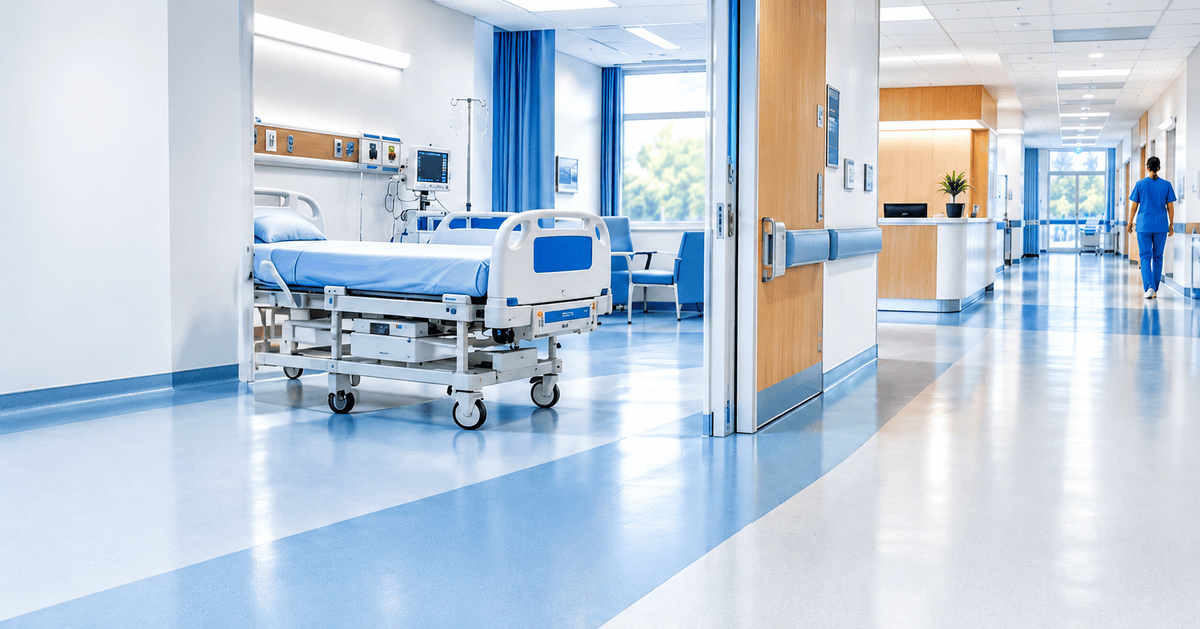
In a hospital, the floor is not just a finish. It is part of infection control, patient safety and the building’s running cost. Every day it takes trolley wheels, wheelchairs, spills, blood, disinfectants and thousands of footsteps. A wrong choice shows up fast: grout lines that hold bacteria, cracked tiles under stretchers, slippery corridors, or a floor that has to be replaced in five years.
India is building and upgrading hospitals at a fast pace, from new AIIMS campuses to private multi-speciality chains. The country’s vinyl flooring market alone was worth USD 12.91 billion in 2025, and healthcare is one of the sectors driving its growth, according to IMARC.
This guide explains what makes a floor “hospital-grade”, which flooring suits each hospital area, what NABH expects, and what it costs per sq ft in 2026.
What Makes Flooring Hospital-Grade?
A hospital floor has to do six jobs at once. Before you compare brands or prices, check that the product meets each of these.
1. Seamless, Heat-Welded Joints
Sheet flooring is laid in wide rolls and the joints are heat-welded with a matching rod. The result is one continuous surface with no gaps where liquids, dust or bacteria can settle. This is the single biggest reason hospitals move away from tiles in clinical zones.
2. Antibacterial Surface
Healthcare-grade vinyl and linoleum are non-porous and often carry an antibacterial surface treatment. Ask for a test report (for example, ISO 22196) instead of relying on a brochure claim.
3. Slip Resistance
Floors in wards and corridors should have a slip rating of at least R10, and wet areas such as toilets and scrub rooms R11 (DIN 51130 scale). Patients on medication, elderly visitors and staff moving quickly all depend on it.
4. Coved Skirting
The floor sheet is curved 100–150 mm up the wall instead of meeting it at a sharp 90° corner. Coving removes the corner where dirt collects, so the floor and lower wall can be cleaned in one pass.
5. Chemical and Stain Resistance
Hospital floors are cleaned several times a day with strong disinfectants, and they face spills of iodine, blood and medicines. The surface must not stain, soften or lose its finish.
6. Durability Under Rolling Loads
Beds, trolleys and equipment carts put heavy point loads on the floor. Look for a thick wear layer, good indentation resistance and a heavy-commercial use class.
A seventh factor, acoustic comfort, matters in wards and ICUs. Acoustic-backed vinyl cuts footfall and trolley noise, which helps patients rest.
What Are the Types of Hospital Flooring?
Homogeneous Vinyl Flooring
A single-layer vinyl where the colour and pattern run through the full thickness. Even after years of wear, there is no printed layer to wear away. It is the most common choice for wards, ICUs and corridors because it is seamless, easy to clean and can be polished back to its original finish.
Heterogeneous Vinyl Flooring
A multi-layer vinyl with a printed design under a clear wear layer. It offers more design options, such as wood or stone looks, and is often used in consultation rooms, OPDs and admin areas with lighter traffic.
Conductive and Anti-Static (ESD) Vinyl
Special vinyl that safely drains static electricity through a copper earthing grid laid under the floor. It is needed in operation theatres, cath labs, MRI and other rooms with sensitive electronic equipment or where static could be a risk.
Linoleum
A natural floor made from linseed oil, wood flour and jute. It is naturally resistant to bacteria growth and is a strong choice for green-certified (IGBC or LEED) hospital projects. It suits wards, offices and paediatric areas, but not wet zones.
Epoxy and PU Resin Flooring
A seamless liquid-applied coating that cures into a hard, chemical-resistant surface. It works best in labs, pharmacies, CSSD, kitchens and service areas. It is harder and colder underfoot than vinyl, so it is less suited to patient rooms.
Vitrified Tiles and Granite
Durable and attractive for lobbies, reception, waiting halls and external ramps. Use anti-skid finishes at entrances. Avoid tiles in clinical zones because grout lines are hard to keep sterile.
Best Flooring for Each Hospital Area
No single floor suits an entire hospital. Specify by zone, based on hygiene risk, traffic and the equipment used.
| Hospital area | Recommended flooring | Key requirement | Indicative cost (₹/sq ft, installed) |
|---|---|---|---|
| Operation theatre (OT) | Conductive / anti-static vinyl or PU resin | Static control, seamless, coved, sterilisable | 250–500 |
| ICU / CCU | Homogeneous vinyl (anti-static where specified) | Antibacterial, acoustic, easy disinfection | 200–400 |
| Wards and patient rooms | Acoustic homogeneous vinyl or linoleum | R10 slip rating, quiet, comfortable underfoot | 150–300 |
| Corridors | Heavy-duty homogeneous vinyl | Rolling-load resistance, R10, welded joints | 150–260 |
| Labs, pharmacy, CSSD | Epoxy / PU resin or chemical-grade vinyl | Chemical resistance, seamless, coved | 180–500 |
| Toilets, scrub and wet areas | Safety vinyl or anti-skid vitrified tile | R11 slip rating, water resistance | 90–260 |
| OPD and consultation rooms | Heterogeneous or homogeneous vinyl | Durable, easy to clean, design options | Similar to wards |
| Lobby and reception | Granite or large-format vitrified tile | Durability, looks, anti-skid at entrance | 130–350 |
Cost ranges are indicative 2026 market rates (Studio Matrx); actual pricing depends on brand, thickness, area and site conditions. Contact CIPL for a project-specific quote.
Vinyl vs Epoxy vs Tiles for Hospitals
| Factor | Homogeneous vinyl | Epoxy / PU resin | Vitrified tiles |
|---|---|---|---|
| Hygiene | Excellent – welded, seamless, coved | Excellent- seamless | Fair- grout lines trap dirt |
| Comfort underfoot | Warm, slightly cushioned | Hard and cold | Hard and cold |
| Noise | Low (acoustic options) | High | High |
| Slip resistance | R9–R11 options | Depends on finish | Anti-skid options |
| Chemical resistance | Good | Excellent | Good (grout is the weak point) |
| Impact and rolling loads | Very good, no cracking | Very good | Can crack or chip |
| Repair | Patch and re-weld a section | Recoat | Replace tiles, re-grout |
| Install time | Fast once subfloor is ready | Needs curing time | Slow, wet work |
| Best for | Wards, ICU, OT (conductive), corridors | Labs, pharmacy, CSSD, service areas | Lobby, reception, ramps |
Verdict: Use vinyl as the default for clinical and patient areas, epoxy where chemicals are handled, and tiles or granite only in public, non-clinical spaces.
NABH and NBC 2016 Flooring Requirements
Indian hospitals seeking NABH accreditation are assessed on infection control and patient safety, and flooring plays a direct part in both. In practice, assessors and hospital infection-control teams look for:
- Washable, non-porous surfaces in all clinical areas
- Seamless floors with no open joints in OTs, ICUs and isolation rooms
- Coved floor-to-wall junctions so no corner can harbour dirt
- Non-slip surfaces in patient areas, toilets and ramps
- Static control in operation theatres and rooms with sensitive equipment
The National Building Code (NBC) 2016 and accessibility rules under the RPwD Act add requirements for slip-resistant, level and continuous surfaces along circulation routes, ramps and accessible toilets, so wheelchair and stretcher movement stays safe.
Tip: Share the flooring product’s technical data sheet, slip-rating test report and antibacterial certificate with your infection-control committee before ordering. It saves rework during the NABH audit.
Hospital Flooring Cost per Sq Ft in India (2026)
For budgeting, plan on roughly ₹150–300 per sq ft installed for ward and corridor vinyl and ₹250–500 per sq ft for anti-static OT and ICU flooring. The material is only part of the bill. These factors move the final price:
- Thickness and wear layer – 2 mm homogeneous vinyl costs more than 1.5 mm but lasts longer in corridors.
- Welding and coving – heat-welded seams and 100–150 mm coved skirting add labour and material, but they are what make the floor hygienic. Never cut them to save cost.
- Subfloor preparation – levelling compound, moisture testing and primer are essential. A poor screed causes bubbling and lifting later.
- Earthing grid – conductive flooring needs a copper strip grid and connection to the building earth, which adds to OT costs.
- Project size and phasing – larger areas usually get better per-sq-ft rates; working in a live hospital at night or in phases can add cost.
- Brand and certifications – internationally certified products cost more but come with test reports that make NABH approval smoother.
Think in lifecycle cost, not purchase price. A quality homogeneous vinyl floor that lasts 15–20 years with low maintenance is usually cheaper over its life than a cheaper floor that needs replacing in 5–7 years.
Installation and Maintenance Tips
Before Installation
- Test the concrete subfloor for moisture; laying vinyl on a damp screed is the most common cause of failure.
- Level the floor with a self-levelling compound so seams weld cleanly and no ridges show.
- Plan seam positions away from high-traffic lines and bed-wheel paths.
- In OTs, have the earthing grid tested and certified before the floor goes down.
Daily and Long-Term Care
- Clean with pH-neutral detergents approved by the flooring manufacturer.
- Avoid harsh solvents or undiluted bleach, which can dull or yellow the surface.
- Wipe iodine, betadine and other staining spills immediately.
- Use felt or soft-wheel protectors on heavy equipment.
- Schedule periodic machine scrubbing and polish restoration to keep the finish like new.
With the right installation and care, homogeneous vinyl typically lasts 15–20 years or more in hospital use.
Hospital Flooring Brands Available at CIPL Gr oup
CIPL Group offers high-quality flooring solutions from trusted brands, suitable for hospitals, clinics, diagnostic centres, and other healthcare facilities.
- Forbo Flooring :- Vinyl flooring solutions suitable for hospital corridors, patient rooms, operation theatres, and healthcare facilities.
- Welspun Flooring :- Carpet flooring solutions suitable for hospital administrative offices, waiting lounges, and other non-clinical areas.
- Mikasa :- Engineered wood flooring suitable for hospital reception areas, administrative offices, and executive spaces.
- Knauf :- Raised flooring solutions suitable for hospital IT rooms, control rooms, and technical facilities.
- Bollard :- Vinyl flooring solutions suitable for healthcare interiors, subject to product specifications and hygiene requirements.
CIPL Group helps healthcare projects select flooring solutions based on hygiene, durability, safety, maintenance, and design requirements.
Why Hospitals Choose CIPL
- One source for the whole building– flooring, hospital ceilings, partitions, doors, sanitaryware and lighting from one supplier.
- Healthcare project experience – CIPL has supplied materials for healthcare clients including AIIMS, Max Healthcare and Fortis Hospital.
- Specification support– help choosing the right product for each zone, with data sheets and test certificates for NABH documentation.
- Ready stock and pan-India delivery through CIPL’s branch network.
Planning a hospital, clinic or diagnostic centre? Get a flooring quote from CIPL Group or call +91 98101 39160. You can also explore our full flooring range and our guide to interior building materials for hospitals.
Frequently Asked Questions
What Is The Best Flooring For Hospitals?
Seamless, heat-welded homogeneous vinyl is the standard for most clinical areas. It has no grout joints for bacteria, resists stains and chemicals, and handles trolley traffic. Operation theatres need conductive or anti-static vinyl, while labs suit chemical-resistant epoxy or PU.
Why Do Hospitals Use Vinyl Flooring Instead Of Tiles?
Tiles have grout lines that trap dirt and bacteria and can crack under heavy trolleys. Welded vinyl forms one continuous, washable surface that can be coved up the wall, so there is no corner for germs to collect.
Which Flooring Is Used In Operation Theatres?
Conductive or anti-static (ESD) flooring, usually vinyl laid over a copper earthing grid, or a seamless PU resin. It controls static near sensitive equipment and stands up to repeated disinfection.
What Is Homogeneous Vinyl Flooring?
A single-layer vinyl with the colour and pattern running through its full thickness. Wear does not expose a different layer, so it lasts longer in high-traffic hospital zones than multi-layer heterogeneous vinyl.
What Is Coved Skirting And Why Is It Needed In Hospitals?
Coving turns the floor sheet 100–150 mm up the wall in a smooth curve. It removes the sharp floor-wall corner where dirt builds up, so the floor and lower wall can be cleaned in one pass.
How Much Does Hospital Flooring Cost Per Sq Ft In India?
Roughly ₹150–300 per sq ft installed for ward and corridor vinyl, and ₹250–500 for anti-static OT and ICU flooring. Welding, coving and subfloor preparation drive the final price.
What Are The NABH Requirements For Hospital Flooring?
NABH expects clinical areas to have washable, non-slip, seamless surfaces that support infection control. Circulation routes must also meet NBC 2016 anti-slip and accessibility rules.
Is Epoxy Flooring Good For Hospitals?
Yes, for labs, pharmacies, CSSD and service areas where chemical resistance matters. For wards and corridors, vinyl is preferred because it is warmer, quieter and more comfortable underfoot.
Is Vinyl Flooring Antibacterial?
Healthcare-grade vinyl has a non-porous surface and often an antibacterial treatment that limits bacteria growth. Ask for the product’s test certificate, such as ISO 22196, before specifying.
How Long Does Hospital Vinyl Flooring Last?
With proper installation and maintenance, quality homogeneous vinyl typically lasts 15–20 years or more. Cleaning with pH-neutral agents and periodic polish restoration extend its life.
Recommeded Blogs
Best Flooring for Hospitals in India (2026): Types, Costs & NABH Requirements
In a hospital, the floor is not just a finish. It is part of infection control, patient safety and the building's running cost. Every day it takes trolley wheels, wheelchairs, spills, blood, disinfectants and thousands of footsteps. A wrong choice shows up fast: grout lines that hold bacteria, cracked tiles under stretchers, slippery corridors, or…
Which Flooring Is Best For Office Cabins?
When designing an office cabin, most people focus on furniture, lighting, wall colours, and storage. But have you thought about how much difference the flooring can make? The right flooring can make an office cabin look more professional, feel comfortable, and stay in good condition for years. Whether you're designing a manager's cabin, a director's…
Best Ceiling Solutions In Delhi | CIPL Group
Choosing the best ceiling solutions in Delhi is an important step in creating functional, comfortable, and attractive interiors. Whether you are designing a corporate office, hotel, hospital, school, retail showroom, or residential property, the right ceiling system can improve the appearance of a space while helping manage lighting, acoustics, and building services. Today, architects, interior…