
Havells vs Polycab: Which Cable Brand Wins For Commercial Projects? (2026)
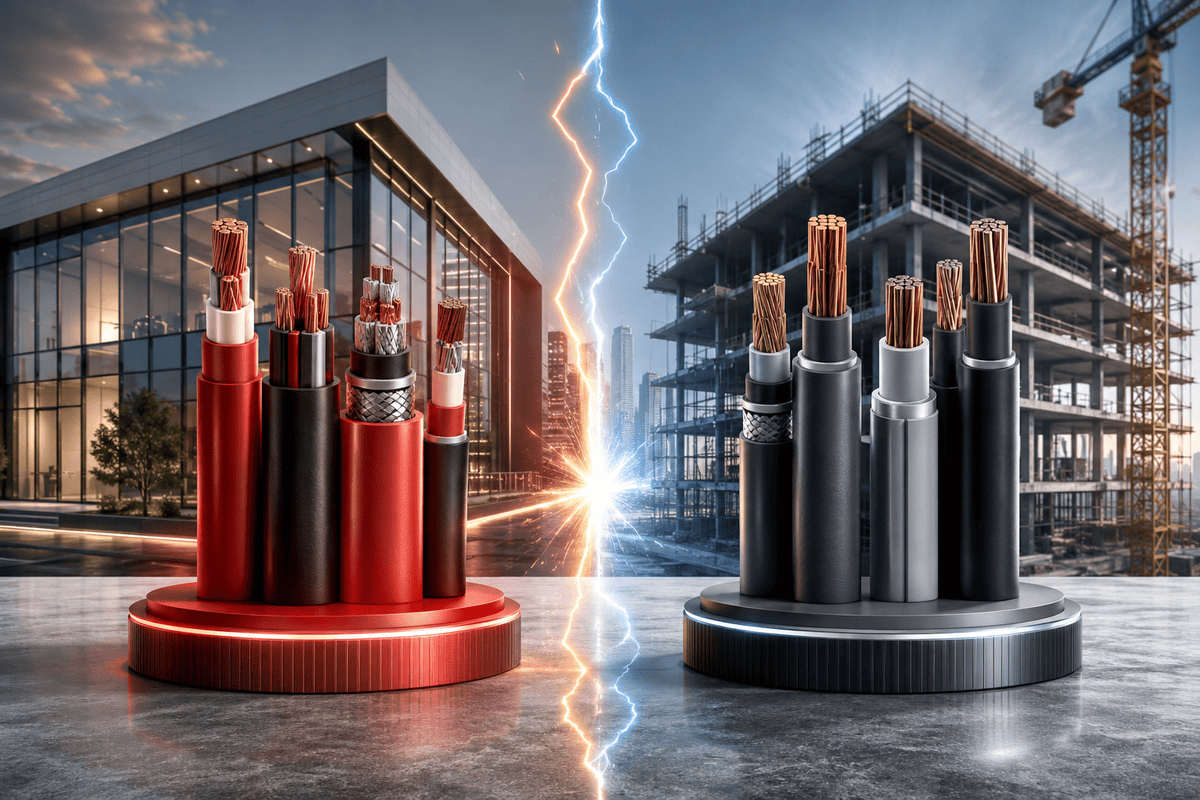
If you’ve priced out wiring for an office fit-out, hospital, hotel, or industrial facility recently, you’ve almost certainly landed on this exact question. Havells and Polycab are the two most-specified cable brands on commercial tenders in India, and contractors, MEP consultants, and procurement teams end up comparing them on nearly every project. The honest answer is that both are legitimate, BIS-certified options but they’re not interchangeable, and the “better” brand depends entirely on what your project actually needs: fire performance, budget discipline, size availability, or turnaround speed.
This guide breaks the comparison down the way a procurement team would actually evaluate it company background, cable types, standards compliance, fire safety grades, copper quality, pricing behaviour, application-specific recommendations, and where each brand tends to get specified on real commercial jobs.
How Does CIPL Group Help You Source The Right Commercial Cables?
Before the brand-by-brand breakdown, it’s worth knowing that CIPL Group has supplied wires and cables for commercial and institutional projects across India since 2006, including brands like Havells, alongside our full range of false ceiling systems, commercial flooring solutions, sanitaryware, lighting, and architectural hardware everything a commercial fit-out needs from one interior building materials distributor. With 11+ branches and a pan-India supply network, our team helps architects, contractors, and developers avoid the two most common electrical procurement mistakes: under-specifying fire-retardant grade for the occupancy type, and choosing a brand purely on price without checking BIS compliance. You can see examples of our material supply work in our completed projects, learn more on our About Us page, or browse our full product range before finalising your electrical BOQ.
Havells vs Polycab: Who Are These Companies, & Why Do They Dominate Commercial Specs?
Havells India, headquartered in Noida and founded in 1958, built its reputation in the consumer and premium FMEG (Fast-Moving Electrical Goods) segment before scaling into commercial and industrial cabling. Its wires and cables division now supplies a significant share of India’s commercial construction sector, manufactured out of facilities including its Haridwar plant, with strong positioning at the premium end of the LT (low-tension) cable market. Beyond cables, Havells’ broader catalogue spans switchgear, lighting, fans, and home automation a diversified base that funds continued R&D in its cable division.
Polycab India, founded in 1996 and based in Mumbai, took the opposite route cables first. It is India’s largest wires and cables manufacturer by revenue, commanding close to a 26% domestic market share in the wires and cables segment, and operates 28 manufacturing plants across the country. Wires and cables still account for roughly 88% of Polycab’s total revenue, which explains why its size range, dealer stock depth, and per-metre pricing are so aggressive compared to more diversified electrical brands. Polycab cables have also found their way into large-scale infrastructure work, including metro rail and major real estate developments, giving the brand deep experience with high-volume institutional supply.
In short: Polycab built its empire on cables. Havells built its empire on being a trusted consumer electrical brand and brought that premium positioning into cables. That single distinction explains almost every difference you’ll read below.
What Types Of Commercial Cables Do You Need To Know Before Comparing Brands?
Before comparing Havells and Polycab head-to-head, it helps to know what you’re actually specifying, because both brands offer overlapping but distinct product lines:
- LT (Low Tension) power cables – used for general power distribution up to 1100V, the backbone of most commercial electrical layouts.
- Control cables – used for signal transmission between control panels, HVAC systems, and building automation.
- Armoured cables – have a metallic layer for mechanical protection, typically specified for underground runs, industrial floors, or areas with physical wear risk.
- Unarmoured cables – used indoors, in conduits or cable trays, where mechanical damage risk is low. If you’re unsure which your project needs, our detailed guide on armoured vs unarmoured cable breaks down exactly when each is required.
- Flame-retardant grades – FR, FRLS, HRFR, LSZH, and HFFR, each offering a different level of fire and smoke protection, discussed in detail below.
Getting this classification right before you compare brand pricing saves procurement teams from apples-to-oranges quotes — a 4-core armoured HRFR cable from one brand should never be priced against a 2-core unarmoured FR cable from another.
Havells vs Polycab: Key Differences At A Glance
| Parameter | Havells | Polycab |
|---|---|---|
| Market position | Premium, consumer-trust led | Volume leader, cost-competitive |
| Copper conductor | High-purity, oxygen-free copper focus | ≥99.97% ETP copper, high purity claims |
| BIS licence | CM/L 7830011 | CM/L 7340134 |
| Governing standards | IS 694:2010, IS 1554, IS 7098 | IS 694:2010, IS 1554, IS 7098 |
| Flame-retardant grades | FR, FRLS, HRFR, LSZH/ZHFR | FR, FR-LSH, HFFR (IS 17048:2018) |
| Best suited for | Hospitals, data centres, airports, premium commercial fit-outs where fire safety is non-negotiable | Large-volume commercial and industrial projects, EPC contracts, cost-sensitive rollouts |
| Price positioning | Generally 8–15% above Polycab on comparable specs | More competitive per-metre pricing across a wider size ladder |
| Distribution | Strong retail + consumer network, deep Tier-1/Tier-2 reach | Stronger B2B, EPC, and institutional project channel |
Both brands are ISI-marked, and BIS licence numbers can be independently verified at bis.gov.in before any bulk procurement — a step every consultant should insist on regardless of which brand you choose.
Which Brand Offers Better Fire Safety For Commercial Buildings?
This is usually the single most important question for anyone specifying cables in an enclosed commercial space offices, malls, hospitals, hotels, or high-rises where the National Building Code (NBC 2016) and local fire authorities increasingly mandate low-smoke, halogen-free cabling.
Havells holds a slight edge here on paper. Its Low Smoke Zero Halogen (LSZH) and HRFR (Heat Resistant Flame Retardant) lines are positioned specifically for high-occupancy, enclosed environments, with HRFR cable rated for continuous operation at 85°C. This makes Havells a frequent first choice for hospitals, metro stations, airports, and data centres spaces where smoke toxicity during a fire is as critical a concern as the fire itself.
Polycab’s flame-grade ladder runs FR, FR-LSH, and HFFR (Halogen-Free Flame Retardant, compliant with IS 17048:2018) a certification that also qualifies it for hospitals, airports, metros, and data-centre installations under NBC 2016. The practical difference for most architects and consultants comes down to which specific flame grade a project’s fire consultant has specified, rather than one brand being categorically “safer” than the other; both meet the same underlying Indian Standards.
Bottom line: if your project has a strict fire consultant sign-off requiring HRFR or LSZH by name, check Havells’ catalogue first. If the spec calls for HFFR under IS 17048, both brands qualify compare on price and lead time instead.
Which Brand Has Better Copper Quality & Conductor Performance?
Copper purity is where the two brands are closest. Polycab publicly claims 99.97% ETP (Electrolytic Tough Pitch) copper purity, while Havells emphasizes oxygen-free copper processing for its conductors. For any commercial or industrial load — HVAC circuits, lighting distribution, server rooms, or heavy machinery the real-world performance difference between the two is negligible. Both conduct efficiently, both minimize resistive heat buildup, and both meet IS 694/IS 1554 conductor requirements.
Where it can matter is on long cable runs with voltage-drop sensitivity large basements, multi-storey risers, or sprawling industrial floors — where consistent conductor uniformity across a big order matters more than a fractional purity claim. On very large single-order runs, some MEP consultants prefer Polycab specifically because of its manufacturing scale and consistency across large batch sizes.
Havells vs Polycab: Which Is More Cost-Effective For Large Commercial Orders?
For bulk commercial procurement, Polycab is generally the more budget-friendly option. Its scale 28 manufacturing plants and the largest wires-and-cables market share in India allows it to hold more competitive per-metre pricing across a wider range of sizes, which is a major factor for large-volume EPC and institutional contracts where even a small per-metre difference compounds across thousands of metres of cable.
Havells typically commands a premium of roughly 8–15% over comparable Polycab specifications, a premium many consultants justify by pointing to its brand reputation, contractor familiarity, and stronger after-sales and warranty support network, especially in Tier-1 and Tier-2 cities.
For a large office park, warehouse, or industrial facility where budget discipline matters and the fire-grade requirement is standard FR or HFFR, Polycab is usually the more cost-efficient specification. For premium commercial interiors corporate headquarters, five-star hospitality, or healthcare where HRFR/LSZH is specified and budget flexibility exists, Havells is frequently the preferred call.
Which Brand Is Better For Different Types Of Commercial Projects?
Cable selection isn’t one-size-fits-all the right brand often depends on the building type:
- Corporate offices: Either brand works well for standard power and lighting circuits, especially when paired with quality architectural hardware and LED lighting as part of the same fit-out package.
- Hospitals and healthcare facilities: Fire and smoke safety take priority, making HRFR or HFFR-grade cable essential, alongside the rest of the facility’s broader material checklist.
- Hotels and hospitality projects: Guest safety codes are stringent, and cable choice should align with the property’s overall fire-safety and interior materials plan.
- Industrial and warehouse facilities: Armoured, high-load-bearing cable matters more here than premium fire grades, making Polycab’s broader industrial size range and pricing usually the more practical fit.
- Retail and showrooms: Standard FR/FRLS grades are typically sufficient, and cost-per-metre often becomes the deciding factor across large retail rollouts.
How Do Havells & Polycab Compare To Other Cable Brands Like KEI And Finolex?
Havells and Polycab aren’t the only names on commercial tenders. KEI Industries is a cable specialist unlike Havells and Polycab, cable manufacturing is effectively its entire business, which makes it a strong third option for large infrastructure and industrial projects, particularly HT (high-tension) cabling. Finolex, meanwhile, sits in a more residential-leaning, mid-range segment, respected for consistent copper quality at accessible pricing, but it’s less commonly specified on large commercial tenders compared to Havells and Polycab. For most commercial and institutional projects in India, though, the shortlist still comes down to Havells versus Polycab, simply because of their combined dominance in commercial cable specification and dealer availability nationwide.
Warranty, After-Sales Support, & Distribution: What Else Should You Consider?
Beyond the cable itself, two operational factors quietly decide project outcomes:
Distribution depth. Havells has built its retail and consumer network over decades, giving it easier residential-style service access in Tier-1 and Tier-2 cities. Polycab’s strength lies in its B2B, EPC, and institutional distribution channel, which tends to serve large commercial and industrial project timelines more efficiently.
After-sales and warranty support. Havells is frequently cited for stronger contractor and consultant relationships built around its premium positioning, while Polycab’s institutional channel is built to handle bulk replacement and large order servicing efficiently. Neither brand should be a concern from a warranty standpoint; both offer standard manufacturer warranties on their cable ranges but if your project needs fast replacement stock in a remote location, checking local dealer inventory before finalising your brand is worth the extra call.
How Should You Choose Between Havells & Polycab For Your Project?
Use this quick checklist before finalising your electrical BOQ:
- Check your fire consultant’s exact specification. If HRFR or LSZH is named specifically, shortlist Havells first.
- Calculate total order volume. For large-volume orders, Polycab’s per-metre pricing usually wins on total project cost.
- Confirm BIS licence numbers for the specific batch you’re buying: CM/L 7830011 for Havells, CM/L 7340134 for Polycab against bis.gov.in.
- Match armoured vs unarmoured cable type to the physical installation environment, not just brand preference.
- Check local dealer stock through your distributor to avoid project delays on non-standard sizes.
- Buy through an authorised distributor rather than unverified sellers, given how frequently both high-demand brands are counterfeited in the open market.
Common Mistakes To Avoid When Specifying Commercial Cables
Even experienced procurement teams run into avoidable issues:
- Comparing mismatched specs. Pricing a 2-core FR cable against a 4-core armoured HRFR cable and calling it a “brand comparison” skews the entire budget.
- Skipping BIS verification. Assuming ISI marking alone is sufficient without checking the licence number invites counterfeit risk.
- Ignoring occupancy-specific fire codes. A retail showroom and a hospital ICU do not carry the same flame-grade requirement, even within the same building type category.
- Over-ordering a premium grade “just in case.” Specifying HRFR where standard FR would meet code inflates project cost without adding compliance value.
- Not accounting for voltage drop on long runs. Undersized conductors on long basement or riser runs can cause performance issues regardless of brand.
Final Verdict: Havells Or Polycab For Your Commercial Project?
There’s no universal winner. Choose Havells if your project is a premium fit-out corporate HQ, five-star hotel, hospital, or data centre where LSZH/HRFR fire performance and brand-backed after-sales support are priorities and budget has some flexibility. Choose Polycab if you’re procuring at scale for an office park, industrial facility, warehouse, or EPC contract, where cost-per-metre across a large order and wide size availability matter more than brand premium. And if your fire consultant has specified a standard HFFR/FR-LSH grade under IS 17048, either brand works the decision then comes down to lead time, dealer stock, and landed cost. Whichever brand you settle on, the non-negotiables stay the same: verify the BIS licence number on the cable jacket, confirm the flame-retardant grade matches what your fire consultant specified, and buy only through an authorised distributor.
Frequently Asked Questions
Which Is Better, Havells Or Polycab, For Commercial Wiring?
Havells is generally preferred for premium fire-safety grades like LSZH and HRFR, while Polycab is preferred for cost-effective, large-volume commercial and industrial supply.
Is Polycab Cheaper Than Havells?
Yes, Polycab is typically priced 8–15% lower than Havells on comparable cable specifications due to its manufacturing scale.
Are Havells & Polycab Cables Both ISI Certified?
Yes, both brands hold valid BIS licences (Havells: CM/L 7830011; Polycab: CM/L 7340134) and manufacture to IS 694:2010 standards.
What Is The Difference Between FR, FRLS, & HRFR cables?
FR resists flame propagation, FRLS additionally reduces smoke density for better evacuation visibility, and HRFR adds high continuous-temperature performance on top of both.
Which Cable Brand Is Best For Hospitals, Airports, & Data Centres In India?
Both brands offer halogen-free, low-smoke options suited to these occupancies Havells’ LSZH/HRFR range and Polycab’s HFFR range under IS 17048:2018.
Can I Mix Havells & Polycab Cables On The Same Project?
Yes, many contractors use different brands for different circuits as long as both meet the flame grade and IS standard specified in the electrical design.
How Do I Verify A Cable Brand’s BIS Certification Before Buying?
Check the CM/L licence number printed on the cable jacket against the official BIS database at bis.gov.in.
Is Armoured Or Unarmoured Cable Better For Commercial Buildings?
Armoured cable suits underground, industrial, or high mechanical-risk installations, while unarmoured cable is standard for indoor conduit and cable-tray runs.
How Does KEI Compare To Havells & Polycab For Commercial Projects?
KEI is a cable-only specialist often preferred for large HT industrial projects, while Havells and Polycab remain the dominant choices for general commercial LT cabling.
Which Brand Has A Wider Dealer Network Across India?
Havells has deeper retail and consumer-facing distribution, while Polycab’s strength lies in its B2B and EPC institutional supply channel.
Recommeded Blogs

Best Flooring for Hospitals in India (2026): Types, Costs & NABH Requirements
In a hospital, the floor is not just a finish. It is part of infection control, patient safety and the building's running cost. Every day it takes trolley wheels, wheelchairs, spills, blood, disinfectants and thousands of footsteps. A wrong choice shows up fast: grout lines that hold bacteria, cracked tiles under stretchers, slippery corridors, or…
Which Flooring Is Best For Office Cabins?
When designing an office cabin, most people focus on furniture, lighting, wall colours, and storage. But have you thought about how much difference the flooring can make? The right flooring can make an office cabin look more professional, feel comfortable, and stay in good condition for years. Whether you're designing a manager's cabin, a director's…

Best Ceiling Solutions In Delhi | CIPL Group
Choosing the best ceiling solutions in Delhi is an important step in creating functional, comfortable, and attractive interiors. Whether you are designing a corporate office, hotel, hospital, school, retail showroom, or residential property, the right ceiling system can improve the appearance of a space while helping manage lighting, acoustics, and building services. Today, architects, interior…